
Speaking Life While You Braid: What to Say During Morning Hair Time
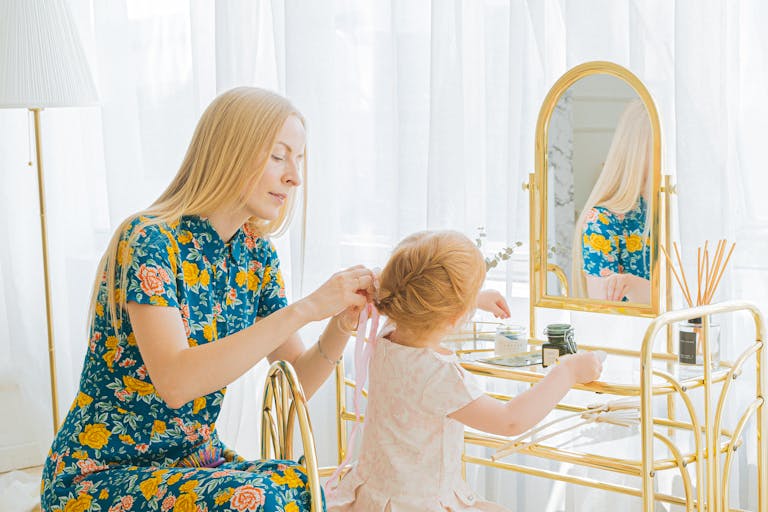
The brush moves through her hair in steady strokes. One, two, three. The rhythm is familiar, comforting. We’ve done this hundreds of times before.
But this morning, I’m paying attention. Not just to whether the part is straight or the ponytail is centered. I’m paying attention to the moment itself.
Because somewhere between the tangles and the braids, between the sprays of the water bottle and the hair elastics, something powerful is happening.
I’m speaking life, or more commonly called in Scripture, words of blessing.
Sometimes it’s intentional. A specific truth I’ve been praying about for weeks, now whispered while I twist her hair into a braid. Sometimes it’s spontaneous. A word of encouragement that bubbles up while I’m securing a bow. Sometimes it’s just presence. My hands in her hair, my attention fully hers, creating a sacred space where she knows she’s seen and valued and loved.
This is what morning hair time has become for us. Not just a grooming routine, but a daily ritual of connection, truth-speaking, and identity-building.
And after twelve years of doing hair for four daughters with different ages, stages, and struggles, I’ve learned something: what we say during these moments matters far more than how the hairstyle turns out.

The Power of the Daily Word
Proverbs 18:21 tells us that the tongue holds the power of life and death. That seems dramatic until you become a mother and realize: my words are shaping how my daughter sees herself, God, and the world.
Research backs this up. Studies show that children who receive regular positive affirmation are more confident, more resilient, and better equipped to handle life’s challenges. The words we speak over our daughters don’t just make them feel good in the moment. They literally shape their neural pathways, influencing how they think about themselves for years to come.
But here’s what I’ve discovered: it’s not just about generic praise or empty affirmations; nor is it false flattery and buildup. It’s about speaking specific, biblical, age-appropriate truth that addresses the real challenges and character development needs of each stage.
A three-year-old needs different words than a thirteen-year-old. The lies a seven-year-old is tempted to believe are different from the ones a seventeen-year-old faces. The character formation that needs to happen at nine looks different from what needs to happen at fifteen.
So over the years, as I’ve brushed and braided and styled hair through every stage of girlhood, I’ve learned to pay attention. To listen for what each daughter needs to hear in this season. To speak the specific truths that will build her up where she’s weak and strengthen her where she’s vulnerable.
This is speaking life and blessing. Not with our own wisdom, but with God’s truth applied specifically to the unique girl He’s placed in our care. This was not necessarily how I was raised so it took some time and practice to change, but the effort has been so worth it in the fruit I have seen in my younger daughters versus my older daughters.
Ages 2-4: Laying the Foundation (Security and Belonging)
Developmental Reality: At this age, your daughter is just beginning to understand that she’s a separate person from you. She’s learning that the world is (hopefully) a safe place where her needs will be met. Her primary question, whether she can articulate it or not, is: “Am I safe? Am I loved? Do I belong?”
Common Fears and Struggles: Separation anxiety, fear of the dark, fear of being left alone, emotional dysregulation (big tantrums over small things), difficulty sharing, strong will emerging.
Character Foundations to Build: Trust in God and in her parents, obedience, gentleness with others, patience (in age-appropriate ways), gratitude.
What to Say While You Do Her Hair:
“You are so loved, sweet girl. Mommy loves you, Daddy loves you, and Jesus loves you most of all.”
“God made you exactly right. He gave you these beautiful curls (or red hair, or brown eyes, or whatever is unique to her). You are His special creation.”
“I’m so glad you’re my daughter. God knew exactly what He was doing when He gave you to our family.”
“Jesus is always with you, even when Mommy can’t be. He never leaves you.”
“Your hands were made to be kind. Let’s ask Jesus to help you use gentle hands today.”
Biblical Truth to Weave In:
Psalm 139:14 – “I praise you because I am fearfully and wonderfully made.” (Simplified: “God made you special.”)
Matthew 28:20 – “I am with you always.” (Simplified: “Jesus is always with you.”)
1 John 4:19 – “We love because he first loved us.” (Simplified: “Jesus loves you so much.”)
Why These Words Matter:
At this age, your daughter is forming her most basic understanding of herself and God. When you speak security and belonging over her every single morning, you’re building a foundation of trust. You’re teaching her that she’s not just tolerated but genuinely delighted in. You’re showing her that God’s love is constant and unchanging, just like your presence during this morning ritual.
This isn’t about making her feel special in an entitled way. It’s about grounding her identity in truth: she is God’s creation, she is loved, she belongs. When these truths are established early, they become bedrock for everything else.

Ages 5-7: The Wonder Years (Obedience and Kindness)
Developmental Reality: These are the golden years of girlhood. Five-year-olds are generally delightful, eager to please, cooperative. Six brings more testing and boundary-pushing. Seven often returns to equilibrium. But throughout these years, your daughter is learning how to navigate friendships, follow rules, and control her impulses. Her primary question is: “What are the rules, and what happens if I break them?”
Common Fears and Struggles: Friend drama (she said/she said), hurt feelings, being left out, fear of failure, perfectionism starting to emerge, tattling on siblings, testing boundaries with parents.
Character Foundations to Build: Cheerful obedience, kindness even when it’s hard, truthfulness, forgiveness, empathy, perseverance when things are difficult.
What to Say While You Do Her Hair:
“I see how kind you were to your little sister yesterday. That made Jesus smile, and it made Mommy’s heart so happy.”
“Obedience is one way we show love to God and to our family. When you obey cheerfully today, you’re saying ‘I trust you, Mom.'”
“You know what I love about you? You have a tender heart. When your friend was sad yesterday, you noticed and tried to help. That’s a beautiful gift God has given you.”
“It’s okay to make mistakes. That’s how we learn. What matters is that we tell the truth and ask for forgiveness when we need to.”
“Friendships can be tricky sometimes. But remember: being kind is more important than being popular.”
Biblical Truth to Weave In:
Ephesians 4:32 – “Be ye kind one to another, tender hearted, forgiving one another, even as God for Christ’s sake hath forgiven you.”
Colossians 3:20 – “Children, obey your parents in everything, for this pleases the Lord.”
Proverbs 12:22 – “The Lord detests lying lips, but he delights in people who are trustworthy.”
Philippians 4:13 – “I can do all things through Christ who strengthens me.” (For when she’s frustrated or wants to give up)
Why These Words Matter:
Between five and seven, your daughter is forming her understanding of right and wrong, kind and unkind, truth and lies. She’s also navigating the complex world of friendships for the first time, which can be brutal even at this young age.
When you speak specific encouragement about kindness and obedience, you’re not just praising good behavior. You’re building character. You’re showing her that you notice when she makes the hard choice to be kind even when her friend was mean first. You’re teaching her that obedience to God and parents is not about control but about trust and love.
These morning words become her internal voice. When she faces a choice between kindness and retaliation, between obedience and rebellion, she’ll hear your voice (and eventually, God’s voice) reminding her who she is and who she wants to become.
Ages 8-10: The Shifting Years (Diligence and Integrity)
Developmental Reality: Eight is often a year of great enthusiasm and energy. Nine can bring moodiness and self-criticism. Ten is typically more balanced. Throughout these years, your daughter is developing a stronger sense of herself as separate from you. She’s becoming more aware of her abilities (and limitations). Her primary question is: “Am I capable? Am I good at things?”
Common Fears and Struggles: Comparison to peers (she’s better at math, she’s faster at running), fear of not being good enough, perfectionism intensifying, increased sensitivity to criticism, friendship betrayals, wanting to quit when things get hard, lying to avoid consequences.
Character Foundations to Build: Diligence and perseverance, integrity when no one is watching, humility (not thinking too highly or too lowly of herself), resilience when she fails, accepting correction with grace.
What to Say While You Do Her Hair:
“I love watching you practice piano even when it’s hard. That’s what diligence looks like, and it’s one of the most important character qualities you can develop.”
“You know what really impressed me? When you told me the truth yesterday even though you knew you’d get in trouble. That took courage, and it showed me your integrity.”
“God didn’t make you to be just like your friend. He made you to be you. She has gifts you don’t have, and you have gifts she doesn’t have. That’s His design.”
“Failing at something doesn’t make you a failure. It makes you human. Even Jesus’ disciples failed constantly, and He kept teaching them.”
“I’m not looking for perfection, sweet girl. I’m looking for faithfulness. God isn’t either. He just wants you to keep trying.”
Biblical Truth to Weave In:
Colossians 3:23 – “Whatever you do, work at it with all your heart, as working for the Lord, not for human masters.”
Proverbs 11:3 – “The integrity of the upright guides them, but the unfaithful are destroyed by their duplicity.”
2 Peter 1:5-7 – “Make every effort to add to your faith goodness; and to goodness, knowledge; and to knowledge, self-control…”
Romans 12:3 – “Do not think of yourself more highly than you ought, but rather think of yourself with sober judgment.”
Why These Words Matter:
This age is when your daughter starts comparing herself to everyone around her. And social comparison is a joy-thief. She notices that her friend is better at reading, faster at running, prettier, funnier, smarter. The temptation to either inflate her ego (pride) or deflate it (despair) is real.
Your morning words become a tether to truth. You’re reminding her that her value isn’t in being the best but in being faithful. That integrity matters more than achievement. That God made her uniquely, not deficiently.
You’re also addressing the lies that lead to character compromise. When she’s tempted to lie to avoid punishment, your words about integrity echo in her mind. When she wants to quit because something is hard, your encouragement about diligence gives her strength to persevere.
Ages 11-13: The Tumultuous Years (Purity and Self-Control)
Developmental Reality: Welcome to the roller coaster. Bodies are changing. Hormones are surging. Emotions are all over the place. Eleven can be anxious and insecure. Twelve often brings rebellion and testing. Thirteen settles a bit but is still dramatic. Your daughter’s primary question: “Am I normal? Why is everything changing?”
Common Fears and Struggles: Body image issues, comparing herself physically to peers and media images, romantic feelings toward boys, wanting to fit in desperately, intense friend drama, emotional volatility (tears over everything), pulling away from parents, questioning faith, shame about changing body.
Character Foundations to Build: Purity in thought and action, self-control over emotions and impulses, modesty rooted in dignity (not shame), discernment about friendships and influences, guarding her heart.
What to Say While You Do Her Hair:
“Your body is changing, and I know that can feel confusing. But every change is exactly what God designed. He’s making you into a woman, and that’s something to celebrate, not hide.”
“Modesty isn’t about shame. It’s about dignity. You dress modestly because your body is valuable and worth protecting, not because it’s something to be ashamed of.”
“I see you noticing boys more. That’s completely normal. But remember: this season is for learning who you are, not for figuring out how to attract boys.”
“Your emotions are real and valid, but they’re not always telling you the truth. When you feel overwhelmed, we can talk through what’s really going on.”
“True beauty comes from a gentle and quiet spirit, which is precious to God. The world will tell you beauty is about your body, but God says it’s about your heart.”
Biblical Truth to Weave In:
1 Peter 3:3-4 – “Your beauty should not come from outward adornment… Rather, it should be that of your inner self, the unfading beauty of a gentle and quiet spirit.”
Proverbs 4:23 – “Above all else, guard your heart, for everything you do flows from it.”
1 Corinthians 6:19-20 – “Do you not know that your bodies are temples of the Holy Spirit… You are not your own; you were bought at a price.”
Psalm 139:13-14 – “For you created my inmost being; you knit me together in my mother’s womb. I praise you because I am fearfully and wonderfully made.”
Why These Words Matter:
This is the age when the lies come in fast and furious. Lies about her body (not thin enough, not developed enough, not pretty enough). Lies about her worth (tied to male attention or peer approval). Lies about her emotions (if she feels it, it must be true).
Your morning words are a lifeline. You’re speaking truth into the chaos. You’re reminding her that her changing body is not a betrayal but a blessing. That modesty protects her dignity rather than hiding her shame. That her emotions are real but not always reliable.
This is also when shame tries to take root. Shame about her body, her feelings, her failures. Your words of affirmation and biblical truth combat that shame before it can take hold.

Ages 14-16: The Identity Years (Discernment and Purpose)
Developmental Reality: Fourteen often brings moodiness, criticism of parents, and intense self-focus. Fifteen tends to be more withdrawn and introspective. Sixteen can swing between childlike and mature. Throughout, your daughter is forming a clear sense of who she is apart from you. Her primary question: “Who am I really? What do I believe?”
Common Fears and Struggles: Identity confusion, questioning faith and family values, intense desire for independence, feeling misunderstood, anxiety about the future, romantic relationships becoming more serious, pressure to compromise values, comparison to idealized versions of life on social media.
Character Foundations to Build: Discernment to recognize truth from lies, conviction to stand firm even when alone, wisdom to make good choices without parental supervision, purposefulness about her gifts and calling, courage to be counter-cultural.
What to Say While You Do Her Hair:
“I love watching you become a woman of conviction. When you stood up for what you believe yesterday, even though your friends disagreed, that took real courage.”
“You’re asking good questions about faith. That’s not doubt, that’s maturing faith. Keep wrestling with these things, and keep bringing them to Jesus.”
“I see you discovering your gifts and passions. God has given you these things for a purpose. He’s preparing you for something specific.”
“The world is going to pressure you to compromise your values. But remember: being popular is temporary. Being a woman of integrity lasts forever.”
“I know you feel pulled in different directions right now. That’s normal. But center yourself in God’s word and prayer every day. That’s your anchor.”
Biblical Truth to Weave In:
Romans 12:2 – “Do not conform to the pattern of this world, but be transformed by the renewing of your mind.”
Philippians 4:8 – “Whatever is true, whatever is noble, whatever is right, whatever is pure, whatever is lovely, whatever is admirable—if anything is excellent or praiseworthy—think about such things.”
Proverbs 3:5-6 – “Trust in the Lord with all your heart and lean not on your own understanding; in all your ways submit to him, and he will make your paths straight.”
Jeremiah 29:11 – “For I know the plans I have for you, declares the Lord, plans to prosper you and not to harm you, plans to give you hope and a future.”
Why These Words Matter:
This is the age when your daughter decides whether the faith and values you’ve taught her are really hers or just yours. She’s testing boundaries, questioning everything, and trying on different identities to see what fits.
Your morning words acknowledge this process instead of fighting it. You’re giving her permission to wrestle while also anchoring her to truth. You’re affirming her growing independence while reminding her of the foundation you’ve laid.
This is also when the culture’s lies become most seductive. Lies about sexual freedom, about identity being fluid, about truth being relative. Your words of biblical wisdom become a compass she can return to when she’s lost or confused.

Ages 17-18: The Launching Years (Wisdom and Confidence)
Developmental Reality: Seventeen brings more independence and maturity. Eighteen often involves preparation for leaving home. Morning hair time may have shifted entirely to bedtime prayer and talks or weekly chats over tea, coffee, or boba. Your daughter is becoming an adult, and the parent-child relationship is shifting to adult-adult. Her primary question: “Am I ready? Can I do this on my own?”
Common Fears and Struggles: Fear of failure in the adult world, anxiety about major decisions (college, career, relationships), feeling overwhelmed by responsibility, sadness about leaving childhood behind, navigating adult relationships and situations, spiritual dryness, questioning calling and purpose.
Character Foundations to Build: Wisdom in decision-making, confidence rooted in God rather than circumstances, spiritual disciplines that will sustain her when you’re not there, resilience when life gets hard, servant-heartedness.
What to Say While You Do Her Hair:
“You’re becoming such a wise young woman. I love seeing how you seek God before making big decisions. That discipline will serve you well.”
“I know you’re nervous about what’s ahead, but I’ve watched you grow in faith and character for eighteen years. You’re ready for this next season.”
“Your identity isn’t in what college you attend or what career you choose. It’s in being a daughter of God. That never changes.”
“Remember that spiritual disciplines aren’t rules, they’re relationships. When you’re on your own, keep pursuing Jesus through prayer, Scripture, and community.”
“You have been equipped for the good works God prepared in advance for you to do. He’s been preparing you for this. Trust Him.”
Biblical Truth to Weave In:
Joshua 1:9 – “Be strong and courageous. Do not be afraid; do not be discouraged, for the Lord your God will be with you wherever you go.”
Ephesians 2:10 – “For we are God’s handiwork, created in Christ Jesus to do good works, which God prepared in advance for us to do.”
Proverbs 3:5-6 – “Trust in the Lord with all your heart and lean not on your own understanding; in all your ways submit to him, and he will make your paths straight.”
2 Timothy 1:7 – “For God has not given us a spirit of fear, but of power and of love and of a sound mind.”
Why These Words Matter:
This is the age when your daughter needs to know: I believe in you. You’re ready. You’ve been equipped.
She needs to hear that her identity isn’t tied to her achievements or decisions but to God’s unchanging love. She needs to know that the spiritual foundation you’ve built together will hold when she’s facing challenges alone. She needs confidence that’s rooted not in her own ability but in God’s faithfulness.
Your morning words become the voice she carries with her. When she’s lonely in a dorm room, struggling in a new job, or facing a moral dilemma, she’ll hear your voice reminding her of who she is and Whose she is.

The Sacred Ordinary
Here’s what I want you to understand: these morning hair moments are not about having the perfect words or the deepest theological discussions every single day.
Some mornings, you’ll speak profound truth. Other mornings, you’ll just say “I love you” and kiss her head. Some days, you’ll pray Scripture over her. Other days, you’ll just be present, your hands in her hair, your attention fully hers.
All of it matters.
Because what you’re really doing during morning hair time is this: you’re showing up. Day after day. Stage after stage. Whether she’s receptive or resistant. Whether she responds or rolls her eyes. Whether the moment feels sacred or completely ordinary.
You’re building a rhythm of presence that says: you are worth my time. You are worth my attention. You are worth these daily words of life.
And over time, these moments accumulate. They form a narrative. They create a foundation. They build a relationship rooted in consistent, loving presence.
Practical Tips for Making This Happen
Here are a few things I’ve learned about making morning hair time meaningful:
Start where you are. If this isn’t your rhythm yet, just start. Even if it’s awkward at first. Even if she’s a teenager and you haven’t done her hair in years. Just start.
Keep it natural. This shouldn’t feel forced or preachy. Weave these truths into normal conversation. Let them arise naturally from what’s happening in her life.
Pray before you braid. Ask God to give you the words she needs to hear. Sometimes He’ll bring a Scripture to mind. Sometimes just a simple encouragement. Trust that He knows what she needs.
Be consistent. The power is in the repetition. This isn’t a once-in-a-while thing. It’s a daily discipline.
Adjust for personality. Some daughters want to talk. Others prefer quiet. Some need direct truth-speaking. Others need gentler suggestions. Know your daughter and adjust accordingly.
Don’t force perfection. Some mornings will be rushed. Some will be grumpy. Some hairstyles will look terrible. That’s okay. You’re building something bigger than perfect hair.
Write them down. Keep a journal of the truths you’re speaking over each daughter. You’ll be amazed at how God uses specific words at specific times.
Your Turn
Proverbs 18:21 reminds us that the tongue holds the power of life and death. Every morning, when you put your hands in your daughter’s hair, you have a choice. You can let these moments be just about hairstyles, or you can make them about so much more.
You can speak life.
You can build character.
You can shape identity.
You can anchor her to truth.
Five minutes. That’s all it takes. Five minutes of presence, of intentional words, of speaking truth over the lies the world will tell her that day.
Don’t underestimate the power of these ordinary moments. Because over time, they become extraordinary. They become the foundation of who your daughter becomes.
So tomorrow morning, when you pick up that hairbrush, remember: you’re not just styling hair. You’re speaking life. And that life-giving work is some of the most important work you’ll ever do.